Clinical Skills
Special Diagnostic Testing
5 lessons·Advanced·AAO/IJCAHPO Standards
1
Visual Field Testing — Humphrey Field Analyzer
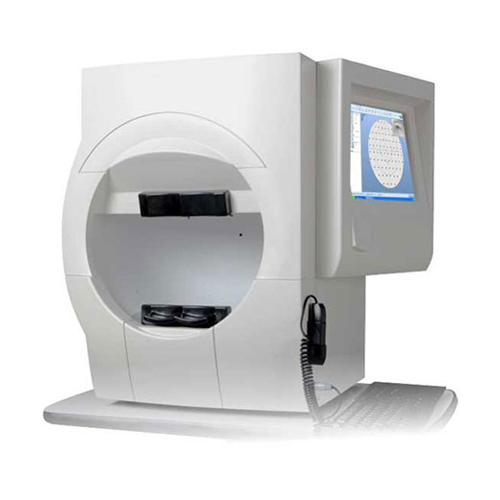
Automated perimetry maps the patient's full field of vision and is essential for diagnosing and monitoring glaucoma, neurologic disease, and retinal disorders. The Zeiss Humphrey Field Analyzer (HFA) is the worldwide gold standard. The patient sits at the bowl perimeter, fixates on a central target, and presses a response button each time a flashing white stimulus is detected. The SITA-Standard and SITA-Faster algorithms shorten test time while preserving accuracy. Key test patterns: 24-2 (most common, 54 points within 24° — primary glaucoma test), 30-2 (extends to 30°), 10-2 (central 10° — macular disease, advanced glaucoma), and Esterman (driver's license screening). Critical setup steps: enter patient demographics and refraction, use the proper near-add trial lens for the patient's age, occlude the non-tested eye, and ensure proper head/chin position with stable fixation. Reliability indices to monitor: fixation losses (<20%), false positives (<15%), and false negatives. Interpret results using the grayscale, total deviation, pattern deviation, MD, PSD, VFI, and Glaucoma Hemifield Test (GHT).
Key Points
- Zeiss Humphrey Field Analyzer (HFA) — gold standard automated perimetry
- 24-2 SITA-Standard: workhorse for glaucoma; 10-2 for macular/advanced disease
- Always set the correct near-add trial lens for patient's age
- Occlude the non-tested eye; verify steady fixation
- Reliability: FL <20%, FP <15%, FN low
- Interpret MD, PSD, VFI, pattern deviation, and GHT together